
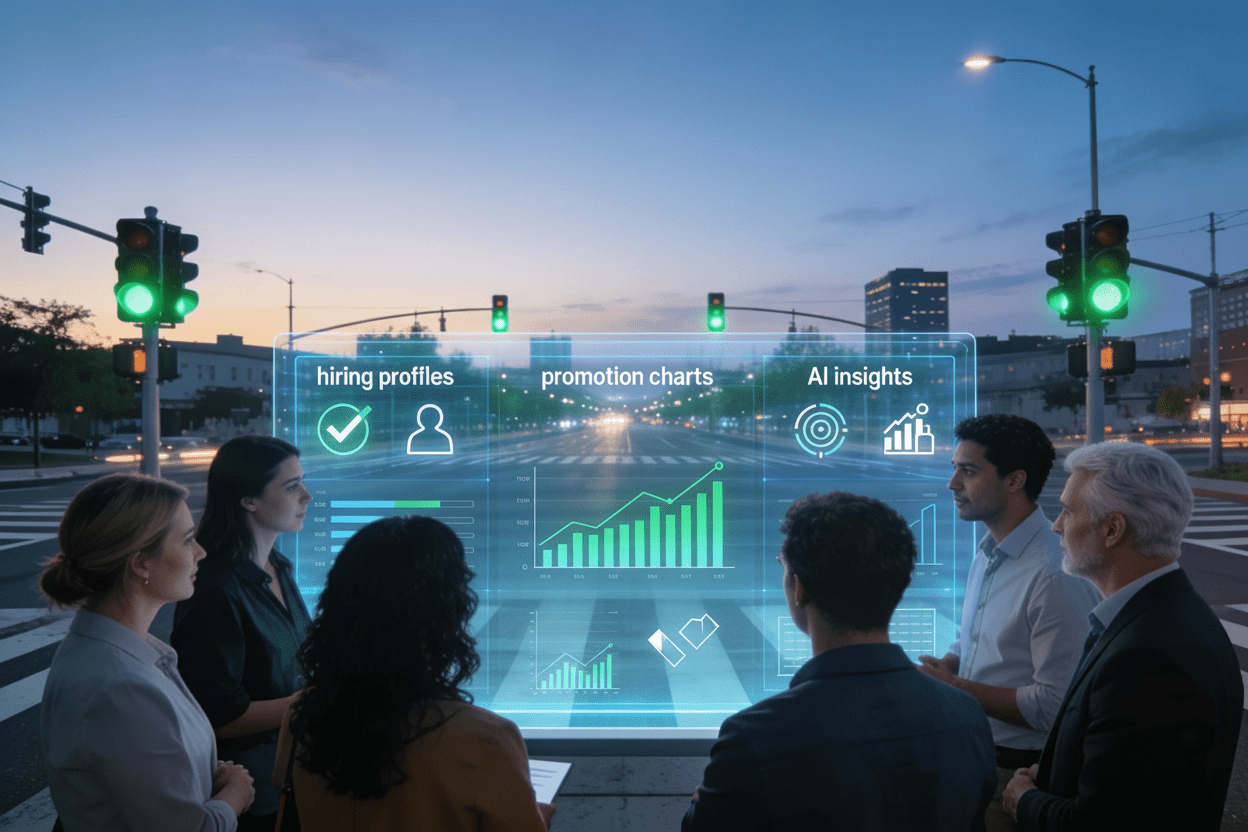
Workforce intelligence governance is reshaping how organizations hire, promote, reskill, and make employment decisions. It is no longer a background concern reserved for policy teams or legal departments. Instead, workforce intelligence governance now sits at the center of institutional accountability.
Think about it like traffic lights in a busy city. Automation can make cars move faster, but without rules, signals, and accountability, speed alone leads to chaos. In the same way, workforce intelligence governance ensures that smart systems don’t just move fast, but move fairly, responsibly, and with human purpose.
Today, workforce platforms do far more than store resumes. In fact, they influence livelihoods. They influence livelihoods. That is why governing them matters more than ever.
What Is Workforce Intelligence Governance?
Workforce intelligence governance refers to the frameworks, oversight structures, and accountability systems that guide automated workforce decision-making. It ensures algorithms support institutions without replacing responsibility.
The Silent Shift in Workforce Decision Making
A few years ago, workforce systems were like digital filing cabinets. They stored employee records, attendance logs, and job applications. Today, they act more like gatekeepers.
If a system does not surface your profile, you might never be considered. If an algorithm ranks you low, a human may never question it. This silent shift has turned tools into decision influencers.
Therefore, that is exactly where workforce intelligence governance steps in. It recognizes that when systems influence outcomes, they must also carry responsibility.
Why Workforce Intelligence Governance Is No Longer Optional
Every hiring or promotion decision has real consequences. It affects income, dignity, and opportunity. Yet many organizations still treat workforce intelligence tools as neutral machines.
These systems are not.
When someone asks why they were rejected or sidelined, “the system decided” is not an acceptable answer. Workforce intelligence governance ensures organizations can explain decisions clearly, calmly, and confidently.
Without governance, trust erodes quietly until it breaks loudly.
Employment Decisions Are Institutional Decisions
Hiring is not like ordering food online. Instead, it shapes careers and lives. It shapes careers and lives. When decisions scale through systems, they become institutional actions, not individual ones.
This is where governed workforce platforms matter. They ensure authority does not drift unnoticed from people to algorithms. Institutions remain accountable, not hidden behind software.
The Hidden Limits of Automation First Systems
Automation promises speed and savings. At first glance, that sounds great. That sounds great, right? But speed without context can harm.
Automation-first systems struggle with human complexity. Career breaks, freelance work, multilingual skills, or non-linear growth paths often confuse rigid models.
Workforce intelligence governance brings balance. It allows systems to assist humans instead of replacing judgment.
Speed Versus Accountability in Hiring
Fast decisions feel efficient. But fast decisions without explanations damage credibility.
Imagine being rejected in seconds with no reason given. Would you trust that system again? Governed workforce platforms slow things just enough to ensure accountability stays intact.
Speed is useful. However, accountability is essential.
How Bias Quietly Enters Automated Systems
In reality, bias rarely arrives loudly. It slips in through historical data.
If past hiring favored certain backgrounds, automation learns that pattern. Without governance, bias does not disappear. It multiplies.
This Workforce intelligence governance introduces checks, reviews, and human oversight. It turns blind automation into responsible intelligence
What Governed Workforce Platforms Do Differently
Governed workforce platforms do not chase perfection. They focus on legitimacy.
They explain recommendations.
In addition, they allow reviews.
Most importantly, they keep humans in charge.
Instead of replacing decision-makers, they empower them with context and clarity.
Ethical Workforce Intelligence by Design
Ethics should not live in a policy document alone. It must live inside the system.
Ethical workforce intelligence is designed to respect fairness, proportionality, and transparency. Governance ensures values are not just stated but enforced.
When systems reflect values, trust grows naturally.
Human in the Loop Workforce Decisions
Human-in-the-loop workforce decisions are not about distrusting AI. They are about owning responsibility.
Someone must be accountable when decisions affect people. Workforce intelligence governance ensures humans remain visible decision owners, not passive observers.
When things go wrong, ownership matters.
Why Explainability Matters More Than Accuracy
A system that is highly accurate but cannot explain itself is fragile.
Explainability builds trust. It allows learning. It supports appeals and corrections. Workforce intelligence governance prioritizes understanding over blind precision.
Accuracy without accountability is like a calculator with no display. It might be right, but you cannot prove it.
Auditability and Long Term Accountability
Over time, decisions do not disappear after they are made.
Decisions do not disappear after they are made. Regulators, courts, and employees may ask questions years later.
Governed workforce platforms make decisions traceable. They allow organizations to reconstruct what happened and why. AI auditability is a foundation.
Designing Inclusive and Modern Workforce Systems
Modern careers are rarely straight lines.
People reskill, switch industries, work across borders, and grow in unexpected ways. Standard scoring models often fail here.
Workforce intelligence governance allows flexibility without lowering standards. Inclusion becomes intentional, not accidental.
Data Ownership and Institutional Trust
Workforce data is deeply personal. It represents lives, not numbers.
Governance clarifies who owns data, how it is used, and why it exists. Purpose-bound data builds trust and reduces risk.
When people trust systems, they engage more honestly.
Regional Realities Shaping Workforce Intelligence
Across the world, different regions expect different safeguards.
Some prioritize explainability. Others focus on data sovereignty or public accountability. Governance-first systems adapt. Automation-first systems struggle.
Workforce intelligence governance prepares organizations for a global future.
Business Outcomes of Governed Workforce Intelligence
Governance is not a cost center. It is a growth strategy.
Organizations that govern workforce intelligence reduce legal exposure, improve employer branding, and attract better talent.
Trust compounds. Risk accumulates.
The Future of Workforce Intelligence Governance
As automation expands, workforce intelligence governance will define which institutions retain legitimacy. Governance-first systems will outperform automation-first models in long-term trust and compliance readiness.
Frequently Asked Questions
What is workforce intelligence governance?
Workforce intelligence governance is the oversight framework that ensures automated hiring and workforce systems remain accountable, explainable, and fair.
Why is workforce intelligence governance important?
It protects institutional trust, reduces bias risks, and ensures organizations can explain employment decisions clearly.
How does governance differ from automation?
Automation improves efficiency. Governance ensures responsibility, transparency, and long-term accountability.
Conclusion
Workforce intelligence governance draws a clear line between efficiency and legitimacy. As systems increasingly shape opportunity, institutions must decide who holds authority. Governed workforce platforms protect people, preserve trust, and future-proof organizations. Automation alone cannot do that. Governance can.